// Activate / Circulate · Buying Guide
Compression Boot Chambers Explained: 4 vs 8 and What Changes
Chambers, zones, fill patterns and pressure, explained without the spec-sheet fog.
"Chamber count tells you how the squeeze is laid out. How you use it is up to you."
// By the Numbers
// The Basics
What Is a Chamber in Compression Boots?
One air cell. One step in the sequence.
A chamber is a separate air cell built into the boot. The compressor pushes air into the cells in a set order, holds, lets the air out and repeats until the timer ends. Each chamber is one step in that sequence.
Picture the leg split into stacked sections from ankle to thigh. With 4 chambers, each section is long. With 8, each section is about half the length, so the squeeze moves up the leg in smaller steps.

// Terms
Chambers vs Zones in Compression Boots
Brands use both words. Here is what they mean.
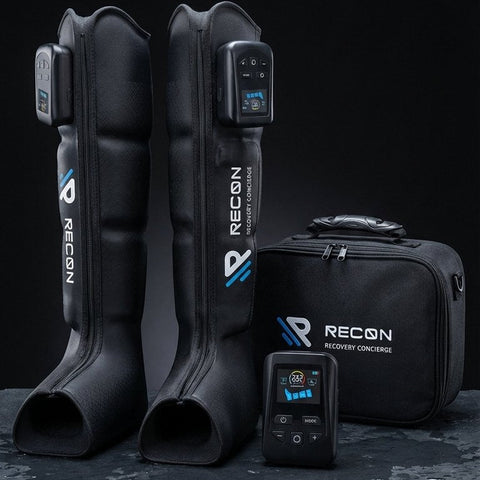
A zone is the area of the leg a chamber covers: foot and ankle, calf, knee, thigh. On the Pro Compression Boots the 4 chambers are the 4 zones, filling in sequence from the ankle up to the thigh.
Some spec sheets count zones and chambers differently, so compare like with like. When you shop, ask two questions: how many separate air cells are in each boot, and what fill patterns can you pick? That tells you more than either word on its own.
// The Big Question
How Many Chambers Do Compression Boots Need?
There is no magic number.
There is no single right number. What changes with more chambers is resolution: an 8-chamber boot can move the squeeze up the leg in finer steps and has more room for different fill patterns. A 4-chamber boot covers the same leg in bigger sections with simpler hardware.
What matters more is whether the boot fits how you recover. RECON Wellness built one of each on purpose:
- 4 chambers: the Pro Compression Boots. Hose-free, compressor on each boot, pressure settings from 30 to 240 mmHg, 5 modes, $575.
- 8 chambers: the Elite Compression System. Touchscreen hub with hoses, 30 to 260 mmHg, 6 modes, runs the hip and arm attachments, $649.
Choosing between them? Pro vs Elite compression boots breaks it down by training style.
Both are part of Activate / Circulate, the compression pillar that leads every RECON Wellness routine after training.
// Fill Patterns
Sequential vs Overlapping Compression, in Plain Words
Same air. Different choreography.
Sequential means the chambers fill in order, usually starting at the foot and moving up. Some patterns fill one chamber at a time and release it before the next. Others build and hold, so lower chambers stay full while the upper ones fill.
Overlapping describes chambers whose edges overlap, or a pattern where the next chamber starts filling before the last one lets go. The goal is a squeeze with no gap between sections as it travels up the leg.
All at once fills every chamber together, holds and releases. It feels like a full-leg hug instead of a wave.

On the Pro, the 4 chambers inflate in sequence from the ankle up to the thigh, and 5 modes give you different patterns to choose from. The Elite has 6 modes across its 8 chambers. Pick the pattern that feels right for the session. There is no wrong answer, and you can change it next time.
// Pressure
Compression Boot Pressure Range, Explained
mmHg is just a unit. Here is how to use it.
Pressure is measured in mmHg (millimeters of mercury), the standard pressure unit on compression gear. Higher numbers mean a firmer squeeze. Both RECON Wellness systems start at 30 mmHg, which is a light, easy session.
The Pro has pressure settings from 30 to 240 mmHg. The Elite adjusts from 30 to 260 mmHg on its touchscreen. You will not live at the top of either range. Start low and step up until it feels firm but comfortable.

| When | Time | Pressure | Notes |
|---|---|---|---|
| After training | 15 to 30 min | About 80 to 160 mmHg | The main use. Compression first, then PEMF, then red light. |
| Before training (optional) | About 15 min | About 120 to 180 mmHg | Then 1 to 2 min of percussion, then your usual dynamic routine. Never the high end of the dial before training. |
| Rest day | About 15 min, kept light | Your comfortable setting; start low and step up | Settle in. Any mode you like. |
Start low and step up. Never push through pain. Stop for numbness or tingling. A compression session never replaces your warm-up. If you have a medical condition, check with your doctor first.
\nFull walkthrough: how to run a compression session after training.
// Pressure
Pressure: Lighter or Firmer?
Here's the honest truth about pressure: more of it doesn't mean better recovery. Some people want a light, easy squeeze, and some want it firmer. Neither one wins. It comes down to what feels right to you.
That said, most of the high-level athletes we work with like it firm. A lot of RECON Wellness users tell us they settle in around 160 mmHg, where the squeeze feels strong but still easy to relax into. And then there's the crew who go past 200. Our founder is proudly one of them.
You have room to find your spot. The Pro has pressure settings from 30 to 240 mmHg, and the Elite adjusts from 30 to 260 mmHg. Start low, give yourself a few sessions, and work up until it feels good. If it ever feels like too much, dial it back. Your session, your call.
// The Lineup
Where Each RECON Wellness Boot Lands
Every point above, mapped to the two RECON Wellness systems.
| Pro Compression Boots | Elite Compression System | |
|---|---|---|
| Chambers | 4 per boot, ankle up to the thigh | 8 per leg |
| Fill patterns | 5 modes | 6 modes |
| Pressure | 30, 50, 80, 100, 120, 140, 160, 180, 200, 220, 240 mmHg | 30 to 260 mmHg |
| Setup | Hose-free, compressor on each boot | Touchscreen hub with hoses |
| Expands to | Legs only | Hip and arm attachments, one at a time |
| Price | $575 | $649 |
Spec-by-spec detail lives on the Pro vs Elite comparison page. If you are putting together the rest of your routine, Renew vs Renew+ covers the PEMF step that follows the boots.
Pro Compression Boots
4 chambers filling ankle to thigh, pressure settings from 30 to 240 mmHg, 5 modes and no hoses. Simple to learn, easy to pack.
See the Pro Compression Boots, $575 →// Where This Fits
The RECON Wellness Human Performance System
Compression leads the routine after training. PEMF and red light follow.
// FAQ
Compression Boot Chambers: Common Questions
Pick Your Chambers
Four chambers and no hoses, or eight chambers and room to grow.
Shop Pro Compression Boots Explore Activate / CirculateLife is the Adventure. The Body is the Vehicle.